

By Sam Syed | Independent World Affairs | March 29, 2026
Estimated Read Time: 14–16 Minutes
It was a Tuesday morning in Minab, a small coastal city in Iran’s Hormozgan province, where the Persian Gulf wind still smells of salt and jasmine. Mothers were walking their daughters to school. Some were already inside the gates of the Shajareh Tayyebeh girls’ elementary school — its name, a Persian phrase meaning “the good tree” — straightening backpacks, tucking in braids, waving goodbye.
It was 8:47 in the morning.
Then the first missile hit.
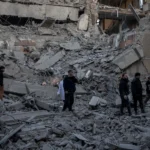
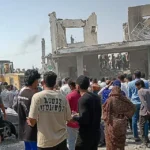
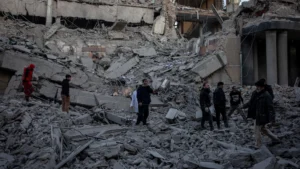
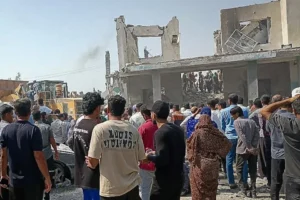
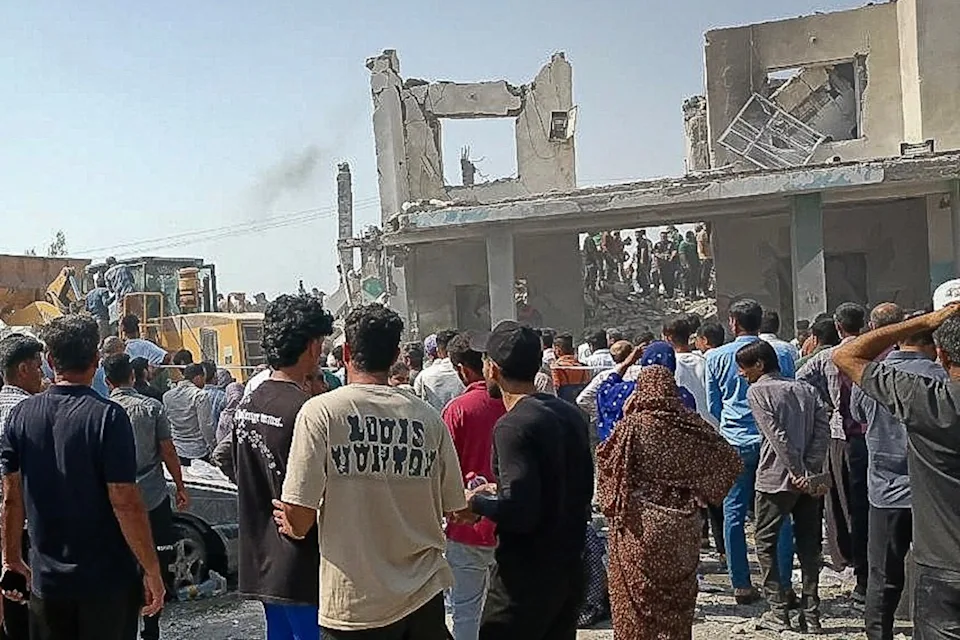
The roof of the Good Tree school collapsed inward, folding over 175 human beings — most of them girls between the ages of 7 and 12 — like a fist closing around a flower. Witnesses told Iranian state media that survivors of the first strike ran into the school hallway. Then a second missile hit. Then a third. By the time the dust settled, Iran’s public prosecutor confirmed that at least 150 “innocent school girls” were still buried in the rubble. Parents who had come to pick up their children were found in the debris alongside their daughters.
A representative of Iran’s Coordinating Council of Teachers’ Trade Associations later told TIME magazine that at least 108 of those killed were children. The school principal was found dead. So were her teachers.
By nightfall on February 28, 2026 — the first day of Operation Epic Fury — Minab had lost an entire generation of schoolgirls.
You almost certainly didn’t see this on your evening news.
The Day the Bombs Fell
On February 28, 2026, the United States and Israel launched a coordinated, multi-wave military campaign against the Islamic Republic of Iran. Under the codename Operation Epic Fury, the strikes targeted Iran’s nuclear infrastructure, military command centres, missile stockpiles, air defence systems, and — according to Washington’s official narrative — only military targets.
Within hours, Iran’s Supreme Leader, Ayatollah Ali Khamenei, who had led the country for 35 years, was dead. Killed in a strike near his offices in Tehran. President Masoud Pezeshkian went underground. The command structure of the Islamic Revolutionary Guard Corps was shattered. The nuclear facilities at Fordow, Natanz, and Isfahan — decades in the making — were turned to craters.
The headlines in New York, Washington, London, and Paris celebrated a military masterstroke.
“In Surprise Daytime Attack, U.S. and Israel Take Out Iranian Leadership,” The Washington Post reported.
CNN ran countdown clocks. Pundits on Fox News called it “one of the most successful preemptive strikes in military history.” Social media erupted with maps, missile trajectories, and explosion footage rendered in crisp satellite imagery.
What the cameras didn’t stay to show was what came next.
The Numbers That Don’t Fit the Narrative
Let’s talk about numbers. Because in war, numbers are the only honest witness we have left.
As of March 27, 2026 — less than four weeks into Operation Epic Fury — the toll on Iranian civilians is staggering:
- Over 1,500 civilians killed, according to Iran’s ambassador to the United Nations
- At least 1,407 confirmed civilian deaths documented by the Human Rights Activists News Agency (HRANA), a US-based rights organisation, through independent field reporting across Iran
- 214 children among the confirmed dead — children who had names, classrooms, and birthday wishes they never got to make
- Over 17,000 civilians injured, including more than 1,500 people under the age of 18
- 3.2 million people displaced inside Iran — the largest internal displacement in the country’s modern history
- 300 health and emergency facilities damaged or destroyed since the war began
- Nearly 20,000 civilian buildings affected in the first 11 days of conflict alone
The WHO issued a formal warning of “grave public health threats” as Iran’s healthcare system began to buckle under the weight of the injured.
UNICEF, the United Nations agency mandated to protect children, described the situation in Iran as “catastrophic”.
These are not Iranian government propaganda figures pulled from thin air. These come from international human rights organisations, UN agencies, and independent monitors — the same standard of sourcing that Western media relies on to cover every other conflict in the world.
But in the case of Iran, those numbers have been buried under the headline: The nukes are gone.
Inside the Hospitals That Are No Longer There
Consider what it means when a country loses its hospitals in the middle of a war.
Iran’s Deputy Health Minister, Dr. Ali Jafarian, told Al Jazeera on March 11 that 25 hospitals had been damaged in the first eight days of conflict, with 9 hospitals now completely out of service. Alongside them, 18 pre-hospital emergency bases were non-functional. 14 ambulances — vehicles whose only purpose is to carry the dying toward life — had been destroyed.
By March 12, the WHO had verified 13 direct attacks on healthcare facilities in Iran. That is not a misprint. Thirteen. Verified. Attacks. On hospitals.
For context: the international community spent months debating a single hospital strike in Gaza. In Iran, thirteen verified attacks on healthcare infrastructure produced a brief paragraph in most Western outlets — if it appeared at all.
Think about what 9 hospitals out of service means in a country suddenly at war. Think about the trauma surgeon who cannot operate because the electricity is gone. Think about the dialysis patient who cannot reach treatment because the road is rubble. Think about the pregnant woman in labour, the diabetic child without insulin, the cancer patient whose last round of chemotherapy will never come.
These people did not choose to build nuclear weapons. They chose to wake up that morning and live their lives. And the war found them anyway.
The School That the World Forgot
The attack on the Shajareh Tayyebeh school in Minab deserves more than a paragraph in a news ticker.
It deserves its own reckoning.
Witnesses on the ground told Iranian state media that the first missile strike hit the main building as children were in classrooms. The second strike hit as survivors scrambled toward a side hallway, a reflex of terror that any human being would recognise. The third strike completed what the first two had started.
Iranian authorities confirmed the school was “triple tapped” — a military term that describes three successive strikes on the same target, designed to eliminate anyone who survived the first hit and rushed to help.
By the end of the rescue operation on March 1, search teams had stopped looking for survivors. 175 people were confirmed dead. The state-run Islamic Republic News Agency counted 150 “innocent school girls” among them. Teachers. Parents who had arrived for pickup. The school’s principal.
When TIME magazine published their investigation into the attack — which carried evidence pointing to an American Tomahawk cruise missile — President Trump was asked directly about the mounting evidence at a press conference. His response was to “claim that another country” was responsible, without naming which country or providing evidence.
No formal Pentagon investigation was announced. No Congressional hearing was called. No major news network ran a days-long primetime series on the children of Minab the way they ran on the children of Bucha, or the children of Beslan, or the children of Sandy Hook.
Ask yourself why.
3.2 Million Souls Without a Home
The United Nations High Commissioner for Refugees, UNHCR, issued a formal report on March 12, 2026, stating that between 600,000 and one million Iranian households — translating to an estimated 3.2 million individual human beings — had been displaced inside Iran since the war began.
“Most of them are reportedly fleeing from Tehran and other significant urban centres towards the northern regions and rural areas in search of safety,” said UNHCR’s emergency coordinator for the Middle East, Ayaki Ito.
3.2 million people.
That is larger than the entire population of Chicago. Larger than the population of Kuwait City. Larger than the populations of Oslo, Copenhagen, and Helsinki combined.
They are sleeping in relatives’ living rooms in villages that have no food supply lines. They are parked on mountain roads in cars stuffed with children and blankets and the photograph they grabbed off the wall when they had 10 minutes to leave. They are the Iranian equivalent of every refugee column you have ever seen in a black-and-white photograph from a war that history now calls a tragedy.
Except this one is happening right now, in colour, and the world is largely looking away.
The UNHCR coordinator warned that the number was “likely to keep increasing” as conflict continues and humanitarian corridors remain absent. There is no formal international refugee operation in place for Iran. No tent city on the Turkish border broadcasting nightly on BBC. No “humanitarian corridor” negotiations dominating EU summits.
There is, mostly, silence.
The Medicine That Will Never Come
Here is a dimension of this war that almost no Western outlet has touched.
For over four decades, the United States’ economic sanctions on Iran made it virtually impossible for the country to import medicine, medical equipment, and pharmaceutical supplies from international markets. The sanctions regime was so comprehensive, so suffocating, that Iran was forced to build its own domestic pharmaceutical manufacturing infrastructure from scratch — factories that produced insulin, chemotherapy drugs, dialysis supplies, antibiotics, and vaccines.
Those factories are now among the buildings that have been bombed.
The Iranian Red Crescent Society confirmed that 13 of its own facilities were damaged in the strikes. Pharmacies across multiple provinces were reported as non-operational. Supply chains for critical medicines — already fragile from sanctions pressure — have been severed by the physical destruction of the roads, bridges, and logistics infrastructure that moved them.
What this means, in human terms, is this: the cancer patient whose chemotherapy medication was produced in a bombed Iranian pharmaceutical factory is now dying on two tracks simultaneously — from their disease and from a war that destroyed their last option.
The WHO warned of “grave public health threats”. They were not speaking theoretically. They were describing what happens when you take a population of 85 million people, already under crippling economic sanctions, and add the systematic destruction of their hospitals, pharmacies, water infrastructure, and medicine supply chains.
You do not need a nuclear weapon to kill millions of people. Sometimes, all you need is enough patience to let the infrastructure die quietly, away from the cameras.
What Western Media Covered — and What It Chose Not To
The Al Jazeera Media Institute published an analysis in early March 2026 that dissected how Western newsrooms have framed Operation Epic Fury, and its findings were damning.
Western outlets consistently used the language of “self-defence” and “preemptive strikes” when describing US and Israeli military action — the same linguistic framework used to justify military operations regardless of the body count they produce. Iranian military actions were framed as “provocations” and “threats” even when they were retaliatory. The death of Supreme Leader Khamenei was treated as a strategic victory, with secondary paragraphs acknowledging, almost reluctantly, that civilians had also been killed.
The same Western media apparatus that spent months documenting Ukrainian children fleeing Mariupol — rightly, and with moral clarity — has given the children of Minab a fraction of that attention. The same editorial ecosystems that built careers on demanding accountability for civilian deaths in other conflict zones have largely declined to apply those same standards to Operation Epic Fury.
This is not a conspiracy. It is something more banal and therefore more dangerous: it is editorial habit. It is the gravitational pull of the dominant narrative. It is the way that certain lives — through decades of repetition, of framing, of whose grief gets centre frame — come to be understood as more real, more newsworthy, more deserving of the front page.
When a Ukrainian school is bombed, the story is the children. When an Iranian school is bombed, the story is the missile system used.
That difference is not journalism. That difference is ideology wearing journalism’s clothes.
The Water That Stopped Flowing
There is a small island in the Persian Gulf called Qeshm. It is home to fishermen, mangrove forests, and some of the oldest salt mines in the world. It is one of the few places on earth where you can still hear a particular kind of silence — the silence of a place that has never been important enough to bomb.
Until now.
A freshwater desalination plant on Qeshm Island was struck in the early days of Operation Epic Fury. The plant, which was the primary source of clean drinking water for 30 villages along the island’s coast, stopped functioning. The residents of those villages — fishermen, teachers, old women, young children — had not built Iran’s nuclear centrifuges. They had not voted for the IRGC’s proxy policy. They had not fired a single missile at Israel.[juancole]
They had just been drinking water.
Now they are not.
That desalination plant is a single data point in a conflict that has produced tens of thousands of them. But it is the kind of data point that tells you something about the texture of this war — about who actually bears the cost of geopolitical decisions made in air-conditioned rooms in Washington and Tel Aviv and Tehran.
The people who suffer are almost never the people who chose the war.
The Silence Is a Choice
By March 27, 2026, nearly 1,500 Iranian civilians had been confirmed killed — and that number was still climbing. The actual figure, accounting for Iranian authorities’ documented pattern of suppressing casualty data, is almost certainly higher. The Hengaw Organization for Human Rights, which operates an independent field monitoring network inside Iran, placed the total civilian death toll in the hundreds and climbing, and noted that Iranian authorities are systematically concealing the full scale of losses.
In other words, the numbers you’re reading in this article are almost certainly the floor, not the ceiling.
The WHO has verified attacks on healthcare. UNICEF has declared a catastrophe. UNHCR has documented the largest displacement crisis in Iran’s modern history. A US rights group has confirmed 214 dead children. A girls’ elementary school was struck three times on the first morning of the war.
And Western media’s primary Iran war story remains the nuclear programme.
Let’s be honest about what that silence represents. Every editorial meeting where the Minab children were not the lead story was a choice. Every hour of cable news airtime spent on missile trajectory analysis instead of casualty documentation was a choice. Every day that the 3.2 million displaced Iranians went unmentioned while maps of the Strait of Hormuz filled the screen was a choice.
Silence in journalism is never neutral. Silence is always a point of view.
What Independent Journalism Owes This Moment
You are reading this on a blog that does not answer to a defence contractor’s advertising budget. It does not have a Pentagon correspondent whose access depends on not asking the wrong questions. It does not have an owner with investments in the energy sector or the arms industry.
What independent journalism owes this moment is simple and enormous: the names.
The name of the school principal at Shajareh Tayyebeh who died with her students. The name of the dialysis patient in Isfahan who could not reach the hospital because it was bombed. The name of the mother on Qeshm Island who has been boiling seawater for her children because the desalination plant is gone.
History does not remember wars through the names of the missiles used. History remembers wars through the names of the people who suffered them. It took decades for the world to properly reckon with the names of Vietnamese civilians killed in US airstrikes. Decades for the world to properly name what happened to Iraqi civilians after 2003. Decades for the architecture of silence to be torn down.
We do not have decades. The war in Iran is happening now.
The children of Minab were buried now. The 3.2 million displaced Iranians are sleeping in unfamiliar rooms tonight, right now, as you read this. The hospitals that are out of service are failing their patients right now.
If you are a journalist, an editor, a blogger, a person with a platform — even a small one — the question is not whether this story deserves to be told.
The question is whether you are willing to be the one who tells it.
A Final Number
The Iranian Red Crescent Society, by early March 2026, had documented damage to more than 20,000 civilian structures in the first 11 days of the conflict alone. That includes homes, schools, health center’s, and their own humanitarian facilities. By the latest count, roughly 82,000 civilian buildings have been affected.
82,000 buildings. Each one a place where someone’s ordinary life was being lived. A kitchen where breakfast was made. A bedroom where children slept. A classroom where a girl was learning to read.
All of it now — rubble or ruin.
This is what the war in Iran looks like when you take the cameras off the missile trajectories and point them at the ground.
Point them at the ground.
Sources: Al Jazeera, BBC Verify, NDTV, Iran International, HRANA (Human Rights Activists News Agency), Hengaw Organisation for Human Rights, UNHCR, WHO, UNICEF, TIME Magazine, The Washington Post, Wikipedia (2026 Minab school attack), ReliefWeb, KOSU.
This article has been independently reported and fact-checked using international human rights monitoring organisations, UN agency reports, and verified news sources. The author does not represent any government or political organisation.
About The Author