

By Sam Syed] | Independent World Affairs | March 29, 2026
Estimated Read Time: 14–16 Minutes
The bombs hit exactly where they were aimed. That is the part Washington got right.
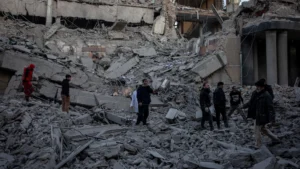
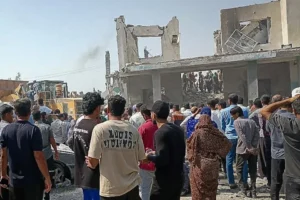
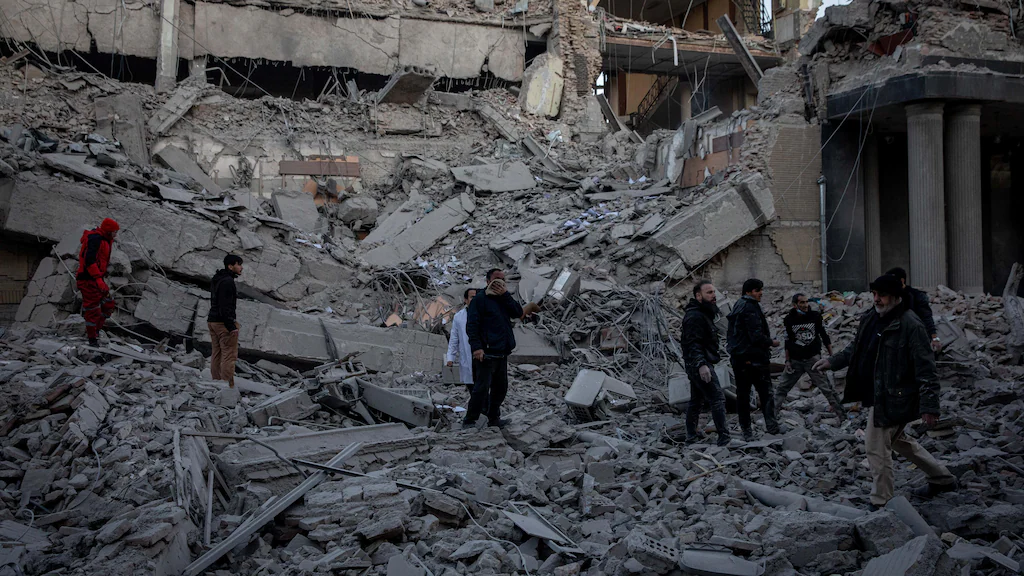
On the morning of February 28, 2026, a coordinated barrage of American Tomahawk cruise missiles, B-2 Spirit bombers, and Israeli F-35s executed one of the most technically precise military campaigns in modern history. Within 72 hours, the nuclear enrichment facility at Fordow — buried under 80 metres of Iranian mountain rock and described by American intelligence as “virtually invulnerable” — was rubble. The centrifuge halls at Natanz, where Iran had spent three decades building uranium enrichment capacity, were gone. The reactors at Isfahan that hawks in Washington had nightmared about for twenty years were silent.
The IRGC’s senior command structure was decapitated. Supreme Leader Ali Khamenei, 85 years old and the most powerful man in the Islamic Republic for 35 years, was killed in a strike near his offices in Tehran. President Pezeshkian went into hiding.
From the perspective of a Pentagon press conference, this was a victory so clean it almost looked easy.
But here is what happened next.
On March 2, 2026 — seventy-two hours after the bombs fell on Tehran — Hezbollah launched missiles from Lebanese soil into northern Israel. Not in disarray. Not as a final, desperate gesture from a dying organization. They launched deliberately, with stated targets, framing the strikes as “retaliation for the killing of Supreme Leader Khamenei”.
On March 12, they did it again — this time firing 200 rockets in a single barrage toward northern Israel, the largest Hezbollah launch since the November 2024 ceasefire. That same night, they targeted IDF Military Intelligence’s Unit 8200 near Tel Aviv with what they described as “advanced missiles“.
On March 24, Iran and Hezbollah launched ballistic missiles at Israel in a joint operation that triggered sirens across large parts of the country.
The nuclear programme was gone. The proxy war was very much alive.
Somewhere in the Pentagon, someone should have been asking a very uncomfortable question: Did we bomb the wrong target?
The Architecture of a 40-Year Network
To understand why bombing Iran’s nuclear facilities did not end the threat, you need to understand what Iran actually built over the past four decades — and how it was designed to survive exactly this scenario.
The Islamic Republic of Iran, from its very first years after the 1979 revolution, understood a fundamental truth about geopolitical survival: a small state surrounded by enemies cannot rely on conventional military power alone. Iran’s army was degraded by the 1980–88 war with Iraq. Its air force was hollowed out by sanctions. Its navy could not project power beyond the Gulf.
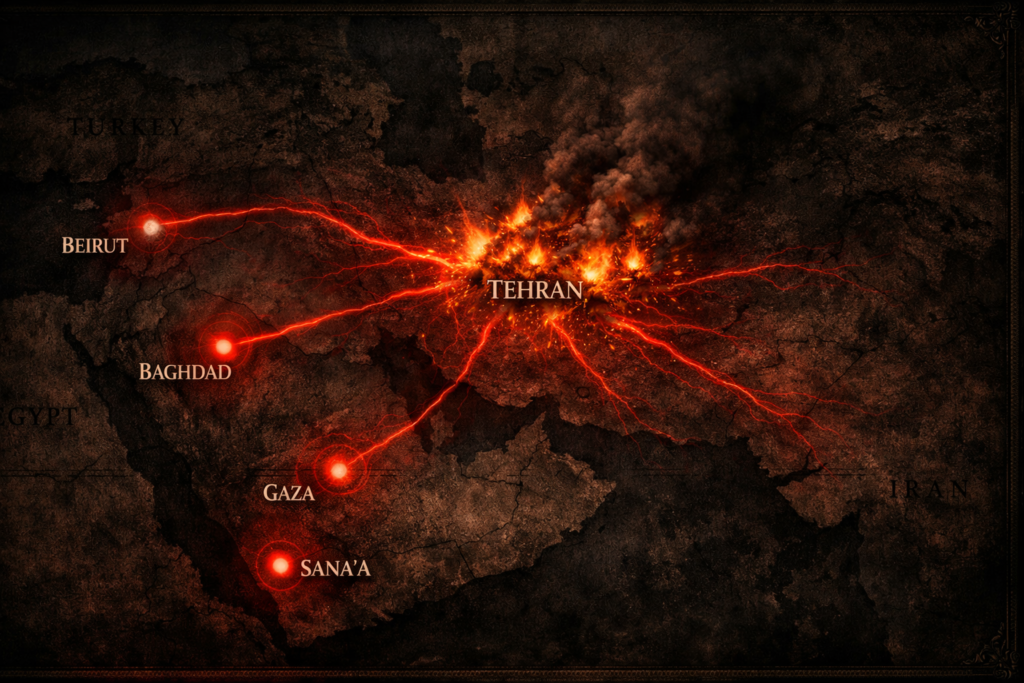
So Iran did something different. It built a distributed human network — a constellation of non-state armed groups, political movements, and militant organisations spread across five countries, each rooted in local grievances but funded, armed, trained, and ideologically oriented by Tehran.
The network today spans:
- Hezbollah (Lebanon): The most powerful non-state armed force in the Middle East, with an estimated arsenal of 150,000 rockets and missiles, a trained conventional military force, a functioning political party with seats in Lebanon’s parliament, and a social services apparatus that has embedded itself into Lebanese civil society for four decadeslatimes
- The Houthis / Ansar Allah (Yemen): Controls Yemen’s capital Sana’a, the Red Sea coastline, and commands the most operationally active drone and missile force among Iran’s proxies — the same group that effectively shut down the Bab el-Mandeb Strait, forcing Maersk, Hapag-Lloyd, and CMA CGM to reroute vessels around Africareuters
- The Islamic Resistance in Iraq (IRI): An umbrella coalition of Iran-backed Shia militias, also known as the Popular Mobilisation Forces (PMF), now formally integrated into Iraq’s state security structure — and already firing drones and missiles at US bases in Erbil and across the regionfdd
- Hamas remnants (Gaza): Severely degraded by the Israeli campaign in 2023–2025, Hamas has been unable to join the current war — but its political and ideological infrastructure still existstheconversation
None of these groups disappear when the IRGC’s senior generals are killed. That was the design.
Built to Lose Its Head
Here is the part that military planners understand but the nightly news never explains: Iran’s proxy network was specifically engineered to function without central command.
The Combating Terrorism Center at West Point noted — even after the January 2020 assassination of IRGC-Quds Force Commander Qasem Soleimani — that the IRGC-QF operates through directorates embedded across Asia, the Levant, Europe, Africa, and even the Americas. The organisation’s operational efficacy was never entirely contingent on any single individual. It was distributed by design, precisely because Iran anticipated and planned for decapitation strikes.irregularwarfare
This is what strategists call “decapitation resilience” — the capacity of an organisation to absorb the loss of its leadership and continue functioning at the operational level. The IRGC did not build a traditional military hierarchy where removing the generals disables the troops. It built a franchise model — regional commanders with pre-authorised operational mandates, locally sourced funding streams, and independently stocked weapons caches that do not require a phone call from Tehran to activate.irregularwarfare
A Newsweek analysis from January 2026, examining the IRGC’s condition after the June 2025 12-Day War, found that despite significant senior leadership losses, the IRGC retained “substantial institutional depth” with an estimated 180,000 personnel. The analysis concluded bluntly: “Losses at the senior level did not disrupt command continuity or operational capacity.”irregularwarfare
The Basij — Iran’s massive paramilitary volunteer force, embedded in every province, every city, every university — remained fully intact.irregularwarfare
In other words: the US and Israel removed the heads. But the body kept moving.
The Day the War Came to Erbil
The morning of March 1, 2026 — just three days after Operation Epic Fury began — explosions were heard at Erbil International Airport in Iraq’s Kurdistan Region, where American troops are stationed.fdd
Within hours, the Saraya Awliya al-Dam (SAD), a member of the Islamic Resistance in Iraq umbrella network, issued a formal statement claiming responsibility for drone and missile attacks on US bases in Erbil.fdd
By the end of March 3, the IRI had collectively claimed:
- 16 drone operations on February 28
- 21 operations using dozens of drones on March 1
- 28 additional operations on March 2
- 27 more missile and drone attacks on March 3longwarjournal+1
That is 92 claimed operations against American bases in four days — from a proxy force that nobody bombed.longwarjournal
For context: these Iraqi Shia militias are not a ragged insurgency firing homemade rockets from pickup trucks. They are formally integrated into Iraq’s Popular Mobilisation Forces (PMF) — a state-recognised security apparatus with tens of thousands of trained fighters, drone manufacturing capability, and weapons supplied over years of Iranian patronage. Some of their commanders sit in the Iraqi parliament.aljazeera
The US hit Iran’s nuclear programme. The US did not hit the 92 operations.
Hezbollah: The Proxy That Outlived Its Patron
Of all Iran’s proxies, Hezbollah is the one that demands the most serious reckoning.
Unlike the Houthis — a regional insurgency that evolved into an Iranian proxy — or the Iraqi militias — coalitions formed largely in the post-2003 chaos — Hezbollah was created and cultivated by Iran’s IRGC from its very inception in 1982. It is Iran’s most mature, most capable, and most deeply institutionalised foreign asset.latimes
By 2026, Hezbollah is not simply a militant group. It is a state within a state:latimes
- It holds seats in Lebanon’s national parliament
- It runs hospitals, schools, and welfare programmes across southern Lebanon and Beirut’s southern suburbs
- Its military wing controls territory along the Lebanese-Israeli border
- Its missile arsenal — estimated at 150,000 projectiles — is the largest held by any non-state armed group on earth
- It has trained fighters with combat experience from Syria, Iraq, and two separate Lebanon-Israel wars
The Jerusalem Post’s military analysts noted that “unlike Hamas, Hezbollah is deeply embedded within its operating environment” — meaning that the political, social, and military dimensions of the organisation cannot be separated and destroyed with airstrikes alone.jpost
When Iran’s command structure was decapitated on February 28, Hezbollah did not wait for orders. By March 2, they were already firing. By March 12, they launched 200 rockets — not as a gesture, but as a declaration. Israeli commentators noted the attack was less an act of aggression than a statement: “a declaration that Hezbollah intends to fight to the end”.npr+1
Iran may be burning. But Lebanon has entered this war.
Yemen’s New Threat: The Double Chokepoint
If Hezbollah is Iran’s most powerful proxy, the Houthis are currently its most strategically dangerous one — and they are threatening to do something that no military strike on Tehran could prevent.
Since the Strait of Hormuz effectively closed following Operation Epic Fury, global shipping companies including Maersk, Hapag-Lloyd, and CMA CGM had already begun rerouting vessels around Africa, away from the Suez Canal and the Bab el-Mandeb Strait. That rerouting added weeks to delivery times and billions in costs to global supply chains.reuters
Now the Houthis are threatening to close the Bab el-Mandeb Strait as well.
The Bab el-Mandeb is a 20-mile-wide waterway connecting the Red Sea to the Gulf of Aden — the entry point to the Suez Canal, through which 10% of the world’s oil and 20% of global container shipping pass every day. On March 25, the US Department of Transportation’s Maritime Administration issued a formal advisory warning that Houthi militants could begin firing on vessels in the Bab el-Mandeb. Houthi leader Abdul Malik al-Houthi had publicly stated his forces were “ready to act any moment”.bloombergyoutube+1
The scenario being discussed in maritime security circles is now called the “Double Chokepoint Crisis” — a situation in which both the Strait of Hormuz (already effectively closed) and the Bab el-Mandeb Strait are simultaneously under threat, making the direct route between Europe, Asia, and the Persian Gulf essentially non-functional.youtube+1
The Houthis are not a nuclear programme. They cannot be solved with a Tomahawk missile. They are 200,000 fighters embedded in the terrain of Yemen, armed with Iranian drones, missiles, and anti-ship weaponry, controlling a coastline that overlooks one of the most critical maritime corridors on earth.
Operation Epic Fury did not touch a single one of them.
The Question That Changes Everything
Military strategist John Phillips, speaking to Al Jazeera on March 2, 2026, described Iran’s current strategy with clinical precision:aljazeera
“Iran’s military approach focuses on surviving the intense pressure from Israel and the US, rebuilding its essential capabilities, and restoring deterrence through calculated asymmetric escalation involving missiles, drones, and proxy forces.”
He then added something that deserves to be read twice:
“Iran can likely sustain intermittent drone, proxy, and cyber operations for years, as these systems are relatively inexpensive and can be produced and deployed from dispersed, fortified facilities, even under sanctions.”
For years.
Not weeks. Not months. Years.
And this is the central, uncomfortable truth that the dominant Western media narrative around Operation Epic Fury has carefully avoided confronting: the nuclear programme was the visible threat — the one that made for clean graphics on cable news, satisfying before-and-after satellite imagery, and a politically legible victory for the governments involved. But it was never Iran’s primary weapon.
Iran’s primary weapon was always the network.
The network that survived 40 years of sanctions. The network that survived the death of Qasem Soleimani in 2020. The network that survived the June 2025 12-Day War. The network that was firing at US bases in Erbil within three days of the largest American military operation since the Iraq invasion.
The Irregular Warfare journal published an analysis on March 9, 2026, with a title so direct it bears repeating: “We Bombed the Wrong Target”.irregularwarfare
Its argument: Iran had anticipated this strike for years. The nuclear programme was deliberately positioned as the target — a strategic offering designed to absorb US and Israeli military power while the real infrastructure of Iranian influence, the proxy network, remained untouched, decentralised, and operational.irregularwarfare
The bombs hit exactly where they were aimed.
That was the point.
The Network That Was Designed to Outlast the Republic
There is one final dimension to this story that almost no Western outlet has explored — and it may be the most important one.
The Stimson Center, in a March 2026 analysis titled “After Khamenei: Regional Reckoning and the Future of Iran’s Proxy Networks,” examined what happens to the proxy network if the Iranian government itself collapses:stimson
“A surviving regime will continue employing proxies as tools of deterrence and influence. However, even if elements of the Iranian state fail, groups such as Hezbollah or Iraqi militias may seek greater accommodation with their host governments, while actors like the Houthis may explore pragmatic understandings with international stakeholders.”
Translation: Iran’s proxies may survive not just an airstrike on Tehran, but the end of the Iranian regime itself.
Hezbollah has its own political identity, its own social infrastructure, its own sources of revenue through Lebanon’s political economy. The Houthis control a capital city and a coastline. The Iraqi militias are part of a formal state security structure. These organisations were built to be extensions of Iranian power — but they were also built to outlive it, because Iran understood that the day might come when the Republic no longer existed to protect them.stimson
The US and Israel destroyed the nuclear programme. They may have also — inadvertently — destroyed the one force that was capable of telling these proxies to stop.
What the Maps Don’t Show
Every evening news segment about this war features the same visual: a satellite map of Iran, annotated with red markers where strikes landed — Fordow, Natanz, Isfahan, Tehran. The markers are satisfying. Discrete. Countable.
What those maps cannot show is the geography of the proxy network — because it does not exist on a map in the traditional sense. It exists in the relationships between IRGC handlers in Beirut and Hezbollah field commanders. It exists in the weapons caches buried under civilian infrastructure in southern Lebanon. It exists in the encrypted communication networks between Iraqi militia commanders and their Iranian patrons. It exists in the Houthi drone factories in Sana’a.
It exists in the habit of 40 years.
And bombs — even very good bombs, even precisely targeted bombs, even historically significant bombs — cannot break a habit.
By March 25, as the US and Israel continued their campaign against Iranian infrastructure, Hezbollah had fired hundreds of rockets at Israel. The Islamic Resistance in Iraq had claimed over 90 operations against American bases. The Houthis were threatening the Bab el-Mandeb. Iranian-backed militias had hit the US Embassy compound in Kuwait.npr
The nuclear programme was gone. The war was everywhere.
The question that every editorial board, every defence analyst, every government intelligence briefing should be asking right now — and that independent journalism has the obligation to ask loudly — is simple:
Did the United States of America spend decades of sanctions, billions of dollars, and the entirety of its credibility in the Middle East destroying the one thing Iran was willing to sacrifice — while leaving the 40-year network that it actually uses to project power completely intact?
The bombs hit exactly where they were aimed.
The question is whether they were aimed at the right thing.
Sources: Irregular Warfare Journal, JINSA Operations Update, Al Jazeera, NPR, Foundation for Defense of Democracies (FDD), Long War Journal, Stimson Center, Reuters, Bloomberg, US Department of Transportation Maritime Advisory, The Conversation, Jerusalem Post, The Los Angeles Times, AFP, BBC.
This article is independently reported and does not represent any government, political organisation, or defence establishment.
About The Author